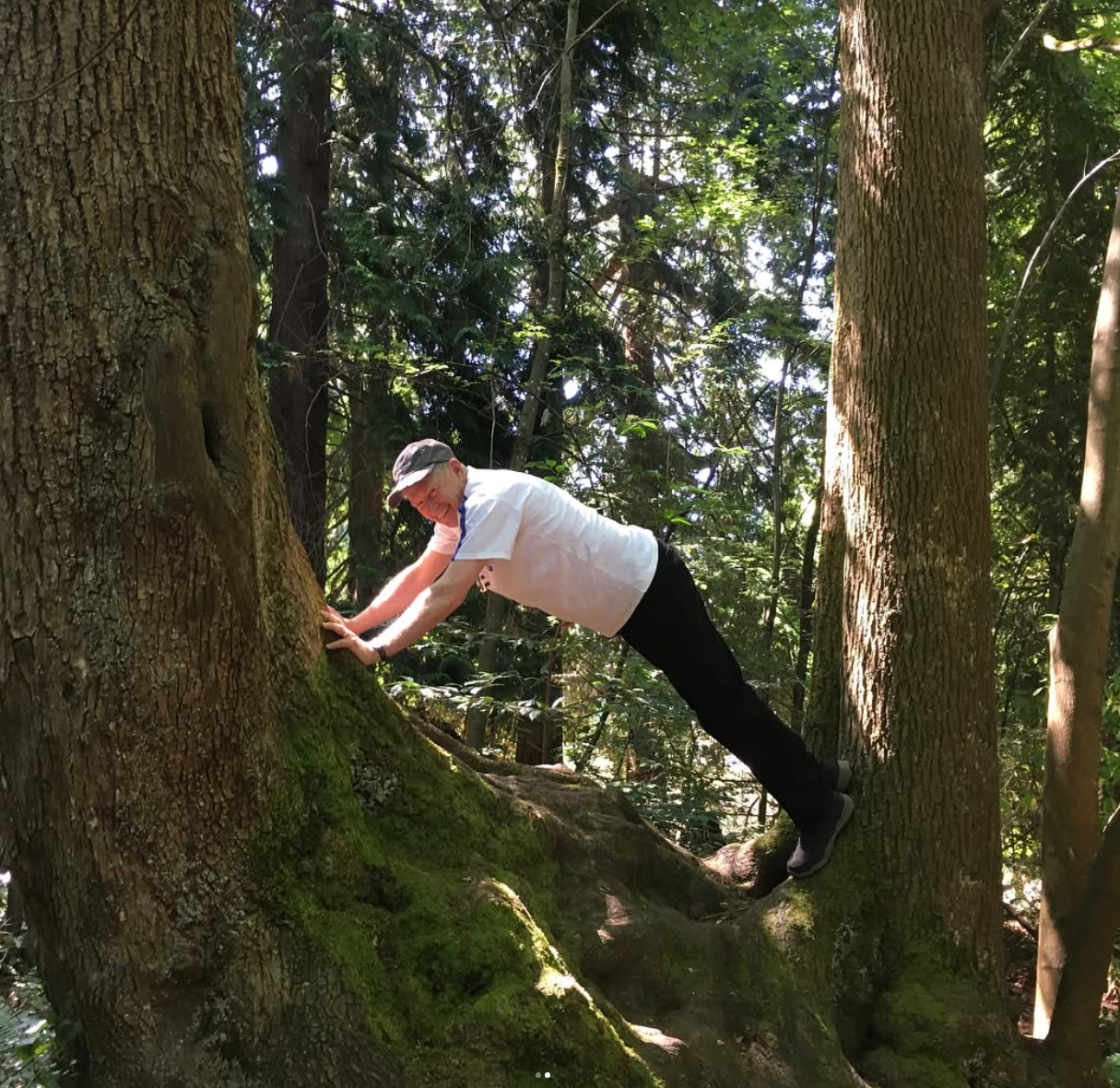
Tom and Crys forehead to forehead

Two Hagens. One life.

Married: 1962
Towns lived in: 11
— Past —
Tom: Engineer, designer, builder, inventor, pilot.
Crystal: Small business owner, floral designer, home maker (as in maker of warm and welcoming, homes.)
— Present —
Two kids, loads of grandkids, heaps of great grandkids.
Status: In love, funny, aggressively helpful, Christ followers, kind, purposeful, living with dementia.

About this blog

  • On Being Human

    On Being Human

    At bedtime most nights, Dad did pushups, then sit‑ups, and then he’d stand at the foot of the bed and somersault in with a twist I never fully understood, landing beside Mom with a grin on his face. 

    Each morning, up first, after stirring cream into his coffee, he’d tap out Shave and a Haircut, Two Bits on the edge of his mug with his spoon, without thinking. Something I find myself doing now and then. 

    A couple of months ago, we nearly missed the elevator leaving their fourth-floor apartment in the retirement community. Dad broke into a full sprint to catch it. For no reason whatsoever.  

    We weren’t late. If it left without us, we could have pushed the button and called it back.  

    My father treats a healthy body the way some people treat a Labrador retriever: What happens if we run over here? 

    That quality gives him a boyishness that has become more noticeable with age. A certain mischievousness.  

    As much as Dad has dedicated his life to serving God, he loves being human. 

    It’s fun. 

    Earlier this summer, my hat blew off at a street fair on the island where we live. Two younger men, maybe in their mid-thirties, jogged after it. 

    Dad bolted. 

    Before the hat could slide beneath a parked car, he passed both men and scooped it up in one motion. Without thinking, I turned to them and said, “He’s ninety-two.” Which, in retrospect, was less information-sharing and more gloating. 

    Dad lettered in everything in high school: football, baseball, basketball — and, for good measure, drama, band, and journalism. Track and field was his favorite. He was a sprinter. He discovered organized races in his late seventies. 10Ks, half-marathons. He was always the winner in his age bracket. It wasn’t even close. He only knew one speed: fast. 
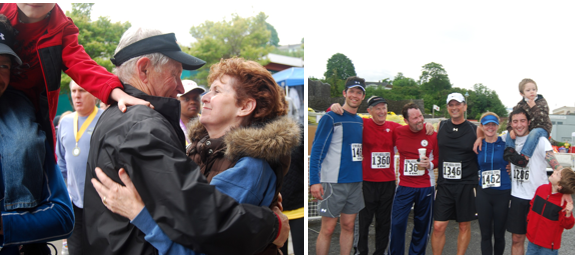
    I ran too. Correction: I casually jogged, with the occasional organized long run. When we ran together, my lungs burned trying to keep up with him. And he never mentioned it when we’d gone well beyond his usual turnaround point. Afterwards, neither of us able to catch our breath, we’d wheeze our way through the front door, greeted by Mom’s look of concern. 

    We’d insist it was great.  

    Let’s do it again sometime. 

    Dad turns 93 this month. 

    He’s recovering from a stroke in a skilled nursing and rehabilitation facility. His body and brain have absorbed the kind of one-two, or maybe one-two-three-four, punch that would take most men out. I knew he was feeling more himself the day a nurse left his room pleased, and he turned and gave me a side-eye and a wink — both of us knowing that the pill was tucked under his tongue the whole time. Dad has never been good at being sick. He hasn’t had much practice. 

    Between PT sessions, we wander the hallways. Dad is greeted with smiles and affectionate fist bumps from the staff and residents. One nurse calls him General. Another calls him Captain. (This one happens to be accurate—he is, in fact, a pilot.) His physical therapist calls him Thomas the Tank. 

    Even if his forgetter weren’t currently overperforming, I don’t think he would remember that he’s not supposed to walk unassisted. His body has always happily taken him where he wanted to go. 

    Up a tree. Down a trail. Across the yard to help a neighbor move something heavy. 

    One afternoon after spending the day with Dad in rehab, I was hiking alone on one of my favorite local hills. As I crossed a wooden bridge, I jumped up and down to test its flex. Feel the bounce. I jumped for a branch that seemed out of reach and felt a rush of satisfaction on contact. I picked up my pace in the steep section, hopping from rock to root and ignoring the ache in my hip.  

    I stopped to catch my breath, leaning back against the trunk of a tree, folding my hands behind my head — a habit that used to annoy my mom when Dad did it — and looked up at the sky. The pause that refreshes, he likes to say. Part vintage Coke ad, part gospel.   

    Not long ago I spotted my great-niece Juniper, in the grass apart from her cousins, good-tired, her little hands folded behind her head, looking up at the sky.  

    Of course, Dad got out ahead of us a long time ago. In the capture of runaway elevators and summer hats. In the jumping for branches. In the small folded hands, the same tilt of the chin. In the rhythm I tap on my own coffee mug without meaning to.  

    She doesn’t know she’s doing it. He never did either.
    Best with sound.

  • Now Look What You’ve Done.

    Now Look What You’ve Done.

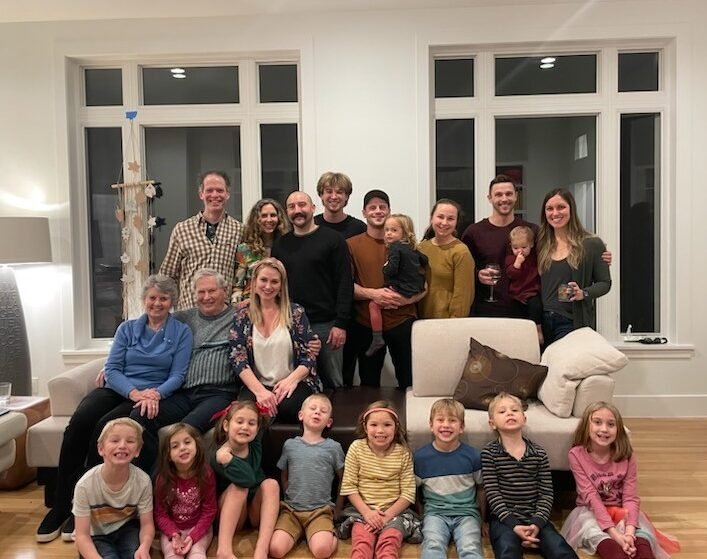
    Here are a lot of us. Certainly not all of us, but enough to get the general idea.

    The photo is a couple of years old now. Two of those littles in the front row are now tweens, which feels impossible.

    Anton and I have strategically planted ourselves in the Seattle area. Conveniently, every airline stops here on its way to Alaska from practically anywhere…

    See what we did there?


  • You still there?

    You still there?

    My parents celebrated an anniversary recently. Sixty-four years of marriage. A small Catholic ceremony in a small church—just a year after they met—on a small street where proximity sometimes rearranges the future.

    Dad had been seeing another young woman and invited her for a big night out: the premiere of West Side Story at Grauman’s Chinese Theatre in Hollywood. It’s enough to make a farm boy from North Dakota feel like he’s starring in his own musical. But she canceled. (If this were a movie, that’s the moment the soundtrack would go plink—fate clearing its throat.)

    The owner of the boarding house where he lived suggested he ask the girl next door. Literally next door.

    Mom had just moved in with her Aunt Crystal—not an actual aunt, but my grandmother’s best friend and the woman my mom was named after.

    He asked. She said yes. And then there they were. My 18-year-old mom in a wedding dress, and my dad in his pompadour leaning in for a kiss—seemingly unaware of his own casual handsomeness.

    Once, on their anniversary, I found myself sharing a one-room cabin in Yellowstone with my parents. I was in high school but knew anniversaries were a couple thing, not a couple-and-their-kid thing. “I’ll disappear for a while,” I offered. “Go for a long hike. Hang out at the lodge.”

    Mom laughed and gave Dad’s hand a squeeze. “Oh, Honey, we’ve been married a long time. You can just walk around the cabin.”

    My parents have only ever shared one regret about our family: that they didn’t have more kids.

    Mom, Dad, Tom Jr., Dawn circa 1966

    They were good at kids. Not just their own. I’ve stopped being surprised when someone I’m just meeting casually refers to my parents as Mom and Dad — only to learn that, in some unassuming way, my parents had parented them too.

    They were also good at bickering, though they’ve largely lost their knack for it over the years. These days they’re more like an extension of each other – sometimes literally. When one is out of sight, the other scans the room for them.

    Whether it’s Mom in my passenger seat or Dad, one of them inevitably reaches into the back seat, a silent check-in.

    You still there?

    If a memory disappears for one, the other colors in the blank spot. Together, they reconstruct a perfectly rational world.

    We’ve started a little ritual. After Dad shaves, I ask Mom to inspect the work. Partly because it seems important that he remember why he shaves: Mom has never liked kissing facial hair. If it were up to him, he’d grow a beard.

    But mostly because I enjoy the theater of it. Mom gamely stops whatever she’s doing and walks over to the freshly shaven Dad. She places both hands on his face and then neck, conducting a careful inspection.

    And every single time, something shifts.

    A soft smile appears. Her whole face seems to remember something.

    Not a shave.

    Something else.

    Maybe every version of him she’s ever loved.

    Cue music.

    Eventually she remembers the assignment and delivers her verdict.

    I never tire of it.

    My dad had a minor stroke a little over a week ago.

    Dad—who has never really had anything seriously wrong with his farm-bred body—is, for the first time, in a hospital bed.

    Mom gently strokes his face with both hands and kisses him.

    Shaved or not.

    Later, without thinking, he reaches for her in the chair next to his bed.

    Sixty-four years later, they’re still checking:

    You still there?


  • The object lesson

    This is my favorite object.

    During a visit some years back, I asked my dad for a pen. He passed me this plastic Franken‑clicker. I doesn’t just work, it thrives—like my dad engineered joy into it on purpose. Its click is absurdly satisfying.

    A tiny monument to my dad’s resourcefulness, wit, and the belief that everything (and everyone) deserves a second life.


  • A small reversal

    A small reversal

    There is no touch like my mom’s. You may think your mom’s touch is the best—I don’t mean to be unkind, but you’re wrong. If you have ever had the pleasure of holding my mom’s hand, or having her stroke your back, or your hair, or your face, you know.

    Growing up, I’d whip off my socks and put my feet in my mom’s lap and, without a word, she’d begin lightly brushing her fingers from my toes to my heel, to my delight. “I have no idea how you tolerate this,” she’d say. “I hate having my feet touched.”

    The other night, Mom was restless and exhausted at the same time. Finally, she sat down on the bed at my promise of a foot massage—which felt odd to even offer her. “Tom,” she said after a few minutes, “have you ever had your feet massaged? It’s amazing! Sweetpea, you’re so good at this. I may want this every day.”


  • High water mark

    High water mark

    2025 marked the 20-year anniversary of Hurricane Katrina. My brother Tom sent a small blurb from the Homer News looking back at the local coverage from that time—coverage that featured my dad. He was a chaplain who’d volunteered with the Red Cross and gone down after the storm to help.

    Helping. That’s kind of his thing.

    Homer News

    I remember talking to him when he came back from New Orleans. He hadn’t slept much. He’d been stationed in a massive sports arena turned shelter—hundreds of cots, hundreds of people, all of them carrying some version of loss: homes, belongings, livelihoods, pets. Some had lost so, so much more.

    It was loud all night. Hot. Smelly. But that’s not why he couldn’t sleep. There was too much to do. So many people in need—victims, first responders, other volunteers running on fumes and determination.

    If there’s work to do, my dad does it.

    Once he built parallel bars for a friend of mine who needed them for at-home physical therapy after a neurological diagnosis—and couldn’t afford them. He measured, researched, designed, and custom-built them. Then he and my mom drove to Los Angeles to deliver them. He’d never met her, but she needed help. He could help. So. Done.

    There were the hitchhikers he picked up over the years—occasionally bringing them home for a meal, sometimes for a night, once for six months so Stan could get back on his feet.

    There was a WWII veteran—dying in the hospital where he chaplain’d—she wanted to ride on a motorcycle again. My dad found someone with a bike and a sidecar. Of course he did.

    And then—when my brother lost his wife, with three boys still at home—he and Mom moved from California to Homer, Alaska. They bought a bed-and-breakfast a short walk, down a dirt path, from the boys’ school.

    The kind of path you don’t think much about until it becomes the path to comfort and unconditional love. Devion, Camron, and Collin walked it almost every day toward grandparents who were now, very decisively, there.

    For as long as I can remember and to this day, no matter what we’re talking about, Dad will say, “So what’s going on? Do you need prayer for anything?” Almost no matter what I say, he answers, “Well, let’s pray about it,” and reaches out his hands to take mine.

    It helps.

    My parents now live in a retirement community whose residents range from independent to memory care. There is no shortage of people who need helping. I walked in the other day and found Mom and Dad praying for another resident.

    Still at it.


  • Cleaning machine

    Cleaning machine

    I’m thinking I may rent my mom out as one of those robo‑vacuums. Drop her off at a house, pick her up an hour or two later — along with a hefty fee, obviously. Floors gleaming. Counters shining. Maybe even a complimentary kitchen reorganization (which, let’s face it, is going to happen anyway). Though I’ll need to add a disclaimer: When in cleaning mode, do not attempt to interrupt. It will only make her stronger.

    She’s always liked straightening up. The results anyway. Our house growing up was always neat — not fussy, not perfect — but the kind of house that, no matter when you stopped by, felt like a hug when you walked in. Lived‑in, but tidy. Lovely. Ready.

    She always had enough on hand to offer a cool drink while you visited in the garden. A meal if you wanted to stay. A bed if you needed one.

    But lately, her need to clean has increased. A drive (hyperdrive, some days) to bring order to things, in a world that increasingly needs it.

    “I can’t help it,” she said to me not that long ago. “It’s a compulsion.” And we both burst out laughing.

    Because it was funny. And also because it was true.

    And then she reached over and flicked a crumb off the table between us. And then leaned over and picked it up off the floor.


  • Ain’t life grand?

    Ain’t life grand?

    Mom, Dad, I—along with anyone I can drag along—spend a great deal of time in the Grand Forest. Grand Forest West, to be specific. I have no idea what goes on over in Grand Forest East, but we’re having none of it.

    Grand Forest West is our happy place. It’s close to where Mom and Dad live and is, as advertised, grand. Giant evergreens. Eye level Ferns. Wildflowers. The works.

    We practice strength and balance as we navigate the well‑groomed trails—hills, rocks, tree roots, all part of the deal. It’s where Mom prunes the forest (lightly, unofficially) or gathers greenery for a makeshift bouquet. It’s where Dad stops to marvel—at the trees, their height, their almost up‑to‑the‑sky straightness—and where we make up stories about why some of them bend, choosing, for reasons of their own, to grow off in a different direction.

    And lately, it’s where I’ve been trying to get Dad used to walking poles. I point out that his strapping grandson Collin swears by them. I casually remind him that the last time we talked to his cousin Sherman, Dad’s same age – 92- he said ‘I’m doing great. Except that when I stand in one place, I fall over, so I use a cane.’ I take a pole to model. Dad takes the other—for a while. Not before offering it to Mom, of course. Never missing an opportunity to share his bounty.

    So I give mine to Mom instead (Dad is, after all, the intended target), and before long he’s twirling his pole like a baton or using it to inspect a mushroom on a tree trunk.

    Meanwhile, Mom—decidedly not the intended target—is out ahead, calling back over her shoulder: she likes the walking pole. Matter of fact. It’s helpful. It makes her feel more stable.

    …win?


  • Love multiplied

    Love multiplied

    The hospital in Big Bear felt closed. Like we’d snuck into a large department store after hours—lights dimmed, hallways mostly quiet. The hospital was on strike, but Camron was ready for life, and we were ready for Camron.

    So there we were—me, Mom, Dad—holding Tom’s firstborn, the first one we met at the very beginning. Sherry came into our lives with four kids already mid-story, and I don’t think we understood yet that they were ours to love.

    We must have looked trustworthy that night. Or at least well-intentioned. Because there we stood, within moments of his big entry, holding this shiny, brand-new human in a darkened corner of a hallway. Left to stare. And wonder.

    Knowing him now, I think we could have dropped him on the linoleum floor, and he would have walked it off—but he had a whole larger-than-life, lionhearted, adrenaline-fueled adventure ahead of him, so it’s best we didn’t.

    Camron wasn’t just a beautiful new baby. He was a prism—when the light hit him just right, all rainbowy, we saw what our family could be. What our family now was. We fell in love. The three of us. With all of them.